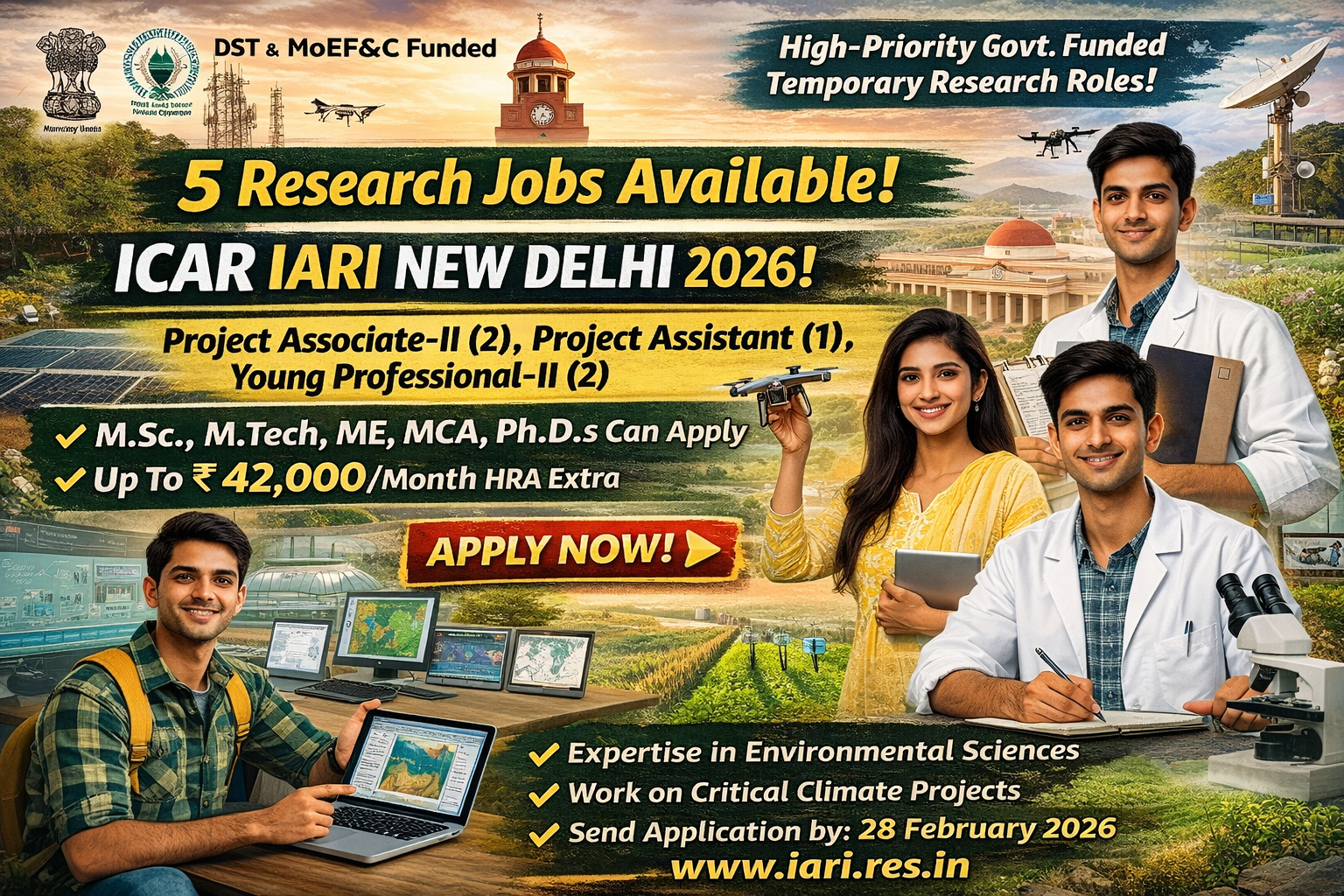




ICAR IARI Recruitment 2026: Project Associate II, Project Assistant & Young Professional II Jobs – Apply Now

Funded by the Department of Science and Technology along with support from the Ministry of Environment, Forest and Climate Change, five temporary roles are open at ICAR–Indian Agricultural Research Institute in New Delhi. The institute has released its hiring notice for 2026, targeting specialists for these posts tied to high-priority research initiatives. While DST backs one set of efforts, MoEF & CC sponsors another, both shaping the scope of work involved. Positions fall under project-based employment, meaning appointments will follow contract terms rather than permanent status. Though based in the capital, responsibilities may extend beyond campus depending on field demands. Announcement details include eligibility, required documents, and submission deadlines accessible through official channels. Each opening connects directly to environmental monitoring or agricultural innovation goals. What drives this round is time-bound funding requiring skilled personnel fast. Hiring decisions will reflect alignment between candidate profiles and project needs. Updates about selection stages appear periodically on the IARI website.

Working here opens doors for those trained in Computer Science, Data Science, Geomatics, Atmospheric Science, Agricultural Sciences, or similar fields. One of India’s top agricultural research centers provides a setting where expertise meets real-world application. Candidates gain experience through active involvement in meaningful projects. The environment supports growth without relying on flashy promises. Each role connects technical skill with practical challenges in agriculture. Opportunities unfold naturally for people ready to contribute. This is not about prestige – it focuses on doing work that matters.

A full overview walks through each key point – starting with role specifics, moving into who qualifies, then steps to apply. Preparation for interviews appears alongside advice shaped by experience. Details unfold without skipping essentials.

Organization Overview

Simple Headline Rewritten Without Fluff Or Structure
ICAR Indian Agricultural Research Institute | New Delhi India
Also Known As | Pusa Institute
Environmental Sciences Division
Projects Involved | DST NMSHE MoEF and CC Funded |
Purely Temporary Contractual Employment
IARI Official Website | www.iari.res.in

Among India’s research centers, IARI stands at the top for farming studies and learning. Being part of this place opens doors to advanced work on shifting weather patterns, long-term farm practices, through environmental analysis.

Vacancy Overview


| Project Associate II | Two Positions | DST NMSHE | Until September 2026 Possibly Extendable |
| Project Assistant | 1 | DST NMSHE | Until September 2026 Likely Extendable |
| Young Professional II | Two Positions | MoEF CC | Until October 2027 Possibly Extendable |

Five items appear in total. A small number fills the count. This amount stands complete. Quantity reaches its limit here. The sum finishes at five

Complete Post-Wise Analysis

Project Associate II NMSHE Project

A key role within the DST-National Mission for Sustaining Himalayan Ecosystems awaits; it focuses on evaluating how shifting climates affect farming across the Himalayas. While one part examines environmental stress on crops, another builds practical responses to strengthen resilience. Though rooted in science, the work connects closely with local conditions. Because changes are already visible, solutions must be both realistic and timely. As data shapes understanding, field insights guide planning. With ecosystems under pressure, new approaches become necessary.

Key Responsibilities:

  • Analyze large-scale climate and agricultural datasets
  • Develop and apply crop simulation models
  • Utilize GIS and remote sensing tools for spatial analysis
  • Contribute to scientific reports and research papers
  • Mentor junior project staff

People who have done solid research work are welcome to apply. Those holding a Ph.D. may find this opportunity suitable. A NET or GATE qualification could be helpful, though not required. Experience in building models matters here. Working with datasets should feel familiar. Strong analytical skills make a difference. This role fits individuals comfortable exploring patterns in complex information.

Project Assistant NMSHE Project

Working here means helping manage geographic information and digital records tied to the Himalayas’ natural systems. A role at this level handles basic tasks linked to mapping tools and organizing environmental datasets. Support duties involve tracking changes across mountain landscapes using computer-based methods. Tasks unfold alongside broader efforts to study high-altitude environments. The work connects directly to maintaining accurate spatial databases. In practice, it means assisting with updates, checks, and routine tech operations. Every contribution feeds into clearer insights about fragile terrains shaped by elevation.

Key Responsibilities:

  • Process satellite images and manage GIS databases
  • Assist in web GIS application development
  • Support for Python R IDL programming
  • Help in crop and pest modeling activities
  • Maintain project documentation

Applicants working in Geomatics, Geo-informatics, or Data Science are suited if they bring hands-on experience with GIS tools. Those focused on spatial data analysis may find alignment through applied projects. Expertise emerges not only from academic training but also real-world implementation. Individuals combining coding abilities with geographic visualization stand out. Backgrounds rooted in mapping technologies often support stronger applications. Practical exposure matters more than theoretical knowledge alone.

Young Professional II MoEF and CC Project

One role sits within the Ministry of Environment’s initiative to draft national reports for the UNFCCC. Two separate positions fall under this opening, each carrying minor differences in qualifications. What sets them apart lies in specific experience needed, though both tie directly to climate reporting duties.

Key Responsibilities Common to Both:

  • Process climate and agricultural data using Python/R/MATLAB
  • Use cloud computing and Google Earth Engine
  • Develop open-source web visualization tools using APIs
  • Analyze climate model data and run simulation models

Special Requirement for One Post:

  • Conduct field observations on crops
  • Use irga and canopy tools

Applicants skilled in coding, drawn to climate simulations, should consider this role. Field-focused positions suit those rooted in plant physiology – or agriculture – yet equipped with technical ability.

Essential and Desirable Qualifications

| Post | Essential Qualification | Desirable Skills |
| :- | :- | :- |
| Project Associate II | (i) Master’s degree in Science or Master’s degree in Engineering or Technology or equivalent in Computer Science/Computer Application/Data Science/Artificial Intelligence/Machine Learning/Geoinformatics/Geomatics/Atmospheric Science/Agricultural Physics/Environmental Science/Agricultural Informatics/Agronomy/Agricultural Meteorology/Plant Physiology/Biochemistry or any branch of Agricultural Sciences with 4/5 years Bachelor’s degree OR (ii) Master’s degree in Science or Master’s degree in Engineering or Technology or equivalent in above subjects with 3 years Bachelor’s degree and 2 years Master’s degree with NET/GATE qualifications OR (iii) Ph.D. in above mentioned subjects | Ph.D. degree, Experience in modeling and programming |
| Project Assistant | MSc/ME/MTech/MCA in Geomatics/Geo Informatics/Computer Applications/Data Science/AI/ML/Data Analytics/Atmospheric Sciences/RS & GIS/Agronomy/Pathology/Entomology or equivalent with First Class or OGPA above 6.0 | Skills in satellite image processing ArcGIS Web GIS GEE Python R IDL programming database management crop and pest modeling |
| Young Professional II | MSc/MTech/ME/MCA/PhD in CS/IT/Data Analytics/DS/AI/ML/Systems/Atmospheric Science/Agromet/Plant Physio/Economics/Climate Sci or equiv First Class OGPA 6+ | Skills data process R Python Linux cloud GEE GIS APIs crop hydro climate model MATLAB field obs IRGA canopy analysis |

Salary and Emoluments

Project Associate-II | ₹35,000/month + 24% HRA | ₹42,000/month + 24% HRA |

Post | Consolidated Salary |

Project Assistant | ₹20,000/month + 24% HRA up to 2 years, ₹23,000/month + 24% HRA thereafter

Post | Consolidated Salary |

Young Professional-II | ₹42,000/month (fixed) |

Housing rent benefit follows established guidelines. Where regulations permit, it becomes part of compensation. Rules determine eligibility clearly. Depending on policy terms, staff may receive this component. Conditions set by authority shape its application. In practice, only those meeting criteria are included.

Age Rules and Exceptions

Category | Age Limits |

General/UR 35 years
OBC (Non-Creamy Layer) 38 years
SC/ST 40 years
Women (All Categories) 40 years

Selection Process Explained

A first step involves a quick review, followed by a more detailed evaluation. One stage comes after another without complications.

Application Review Begins
Every application arriving before the close of 28 February 2026 undergoes review.
Selection begins with a review of each applicant’s grades, measured by percentage or CGPA. Those who meet the required academic thresholds move forward. Qualifications tied closely to the role play a key part in this step. Performance in prior education shapes early decisions. Only individuals matching both score benchmarks and background criteria advance further.
Interview invitations go out by email – but only to those on the shortlist.

Online Interview Stage Two
Set for early March 2026, possibly the fifth or sixth.
Access happens through the web – updates arrive by email.

  • Panel will assess:
  • Subject knowledge
  • Programming GIS Modeling
  • Research experience
  • Problem-solving ability
  • Communication skills

Final Selection
Judging by how candidates answered questions during talks.
Documents were checked when employment began.

Note this carefully – no test on paper will take place. Instead, evaluation follows a different path entirely.

Preparing for an Online Interview

Technical Preparation

  1. Programming Languages:
  • Python Libraries for Data Analysis: Pandas NumPy SciPy Matplotlib
  • R: Practice data manipulation (dplyr, tidyr) and visualization (ggplot2)
  • MATLAB required only for certain YP-II applications
  • IDL used in image processing jobs
  1. Geospatial Technologies:
  • ArcGIS/QGIS: Layer management, spatial analysis, map creation
  • Google Earth Engine Processes Satellite Data Using JavaScript or Python
  • Web GIS basics with Leaflet and OpenLayers
  1. Modeling Skills:
  • Crop Simulation Models: DSSAT and APSIM
  • Hydrological Models: SWAT HEC HMS
  • Climate models (CMIP6 data handling)
  1. Theoretical Concepts:
  • Climate change and agriculture interactions
  • Greenhouse gas emissions
  • Crop physiology and growth stages
  • Remote Sensing Indices: NDVI LAI SAVI

Soft Skills and Interview Approach

Start by understanding every part of your resume. When it comes to academic work, expect questions about projects you completed during your studies. The focus might shift to your thesis – be ready to explain its purpose clearly. Publications listed could come up, so review them thoroughly before speaking. Details matter most when someone asks what you actually did.

Start by exploring what NMSHE means – focus on mountain environments across the Himalayas. Look into how countries report climate actions under UNFCCC guidelines. Curiosity matters more than checklist thinking here. One way to engage is through recent policy documents tied to ecological monitoring. Another path opens via case studies on regional conservation efforts. Interest should come through in questions asked, not just answers given. Depth grows when attention shifts from facts alone to real-world implications.

When faced with a research challenge, start by outlining your initial steps clearly. Think through the scenario logically before sharing your response. Focus on clarity instead of speed. A methodical breakdown often reveals useful angles early. Stay flexible as new details emerge. What matters most is how you adapt along the way.

Start by arranging mock interviews alongside peers or advisors, focusing heavily on technical challenges. Try pairing practice sessions with feedback loops through experienced individuals nearby. Build confidence slowly during these trial runs involving complex problem-solving tasks. Work step-by-step with someone familiar with industry expectations. Refine responses over time using real-time input from those who’ve faced similar evaluations.

Step-by-Step Application Guide

Download Application Format
Following the structure outlined on pages four and five ensures alignment with requirements. As detailed in the official notice, adherence matters most at submission time. Page layout from those sections guides proper presentation clearly. Details must match exactly what appears in that documented framework. Format rules there remain non-negotiable for acceptance.

  • Do not use any other format.

Filling Out the Application Form
Take time to complete each section properly
Details like a person’s full name appear first. Following that comes the name of their father. The day, month, and year when they were born come next. Location details include where they currently live
Email ID and Mobile Number

  • Category (General/OBC/SC/ST)
    Educational Qualifications From Tenth Grade Onward
  • Research experience (if any, with complete details)
    Papers released, should there be any
  • Technology/software developed

Gather Scanned Documents
Collect self-attested scanned copies of:
Class X Marksheet Certificate
Class 12 Marksheet and Certificate

  • Bachelor’s degree marksheets and certificate/provisional certificate
    One step beyond undergrad, a master’s brings official proof through mark sheets plus a diploma or temporary paper showing completion
    A doctoral degree confirmation, provided it exists
    Should you have it, include the NET/GATE certification here
    Experience certificates might be included, when available
  • Publications (PDFs)
  • Recent passport-size photograph
    Birth date verification required when Class X certificate lacks such details

Write the email

  • To: dk6473@gmail.com
  • Subject: Application for Project Associate II under NMSHE project
    Starting with the submission, enclosed is the completed application form alongside required paperwork. Following up on prior communication, supporting files accompany this message. Included here are materials relevant to the position under discussion. Moving forward, documentation necessary for review has been attached. Supporting details appear within the attachments sent herewith.

Send Email
Include every document, ideally compiled into one PDF or split into clearly structured separate files.
Before the date of 28 February 2026 arrives, submission should happen. Reaching the recipient earlier than that point in time remains necessary.
A duplicate of the message remains saved, just in case it is needed later.

Documents Required Checklist

| Document List With Self Attested Scan | Requirement |
| :- | :- |
| Completed application form | ✅ |
| Class 10 mark sheet and certificate | ✅ |
| Class 12 mark sheet and certificate | ✅ |
| Bachelor’s degree all years mark sheets | ✅ |
| Bachelor’s degree certificate/provisional | ✅ |
| Master’s degree all semesters mark sheets | ✅ |
| Master’s degree certificate/provisional | ✅ |
| Ph.D. degree certificate (if applicable) | ✅ |
| NET/GATE certificate (if applicable) | ✅ |
| Experience certificates (if available) | ✅ |
| Publications (reprints/PDFs) | ✅ |
| Recent passport-size photograph |
| Caste certificate (if applicable) |

Important Dates

| Event | Date |
| :- | :- |
| Notification Release Date | 4 February 2026 |
| Last Date to Apply | 28 February 2026 |
| Interview online – tentatively | March 5 or 6, 2026 |

Applicants chosen will receive details about reporting procedures. Information on when and where to report arrives after selection.

Terms and Conditions

  1. Temporary roles fill on a contract basis only. These appointments last exactly as long as the project itself. Employment ends when the project concludes, without extension. Each role exists solely within the project timeline.
  2. Appointments made through this process do not lead to permanent positions within IARI or any institution under ICAR. Once chosen, individuals hold their role without assurance of continued service beyond the specified term.
  3. Online interviews are required. Travel costs receive no reimbursement. Participation happens remotely by design.
  4. Verification occurs when staff begin employment – original paperwork must match records exactly. Should inaccuracies appear, hiring stops without delay. Entry void if details were misrepresented earlier.
  5. Should a candidate have family working at ICAR-IARI, such information needs disclosure. Omitting this detail could result in disqualification.
  6. A job offer depends on clearance from current employers. Those already working need official permission before starting. Hiring happens only after submission of a No Objection Certificate upon joining.
  7. Should circumstances require, the Director of ICAR-IARI may call off or delay an interview at their discretion. A contract might be ended by the Institute even if no explanation is given. At any point, the authority rests with the Director to make such decisions. No justification will necessarily accompany these actions taken under institutional powers.
  8. Disputes will see resolution solely through courts located in New Delhi. Where legal matters arise, authority rests exclusively within that city’s judicial system. Only these tribunals hold power to decide such cases. The geographic limit on venue remains strict – no other region applies.

Comparative Analysis Which Post Is Right For You?

Salary | ₹35k-42k + HRA | ₹20k-23k + HRA | ₹42k fixed |
Eligibility Bar | Very High: NET/GATE/PhD | High: Masters degree | Very High: Masters/PhD |
Work Focus | Modeling, team leadership | GIS, mapping, data support | Simulations, coding, field work |
| Best Suited For | Experienced Researchers PhD Holders GATE Qualifiers | GIS Geoinformatics Specialists | Data Scientists Climate Modelers Plant Physiologists |
| Future Scope | Ph.D. pathways, research careers | Entry into scientific research | Climate policy, global projects |

Frequently Asked Questions

1. Does this position offer long-term employment under public sector terms?

Temporary by design, these roles exist only for the duration of particular initiatives. Tied to contracts rather than long-term appointments, they fall outside the scope of permanent public sector employment.

2. Eligibility for Project Associate II Without NET/GATE?

A four- or five-year bachelor’s program, such as B.Tech, B.E., or B.Sc Agri, paired with a master’s, meets eligibility. However, holding just a three-year B.Sc before a master’s changes things – here, passing NET/GATE or completing a PhD becomes required. Length of initial degree shapes what comes next. Criteria shift based on that starting point.

3. Application fees – do they exist here?

Wrong. Not a single mention of an application charge appears in the notice. Getting started costs nothing at all.

4. What if I am already working somewhere?

Should selection occur, an NOC from your present employer becomes necessary upon joining. Possession of this document is expected before employment begins. Without it, entry into the role may be blocked. The requirement stands regardless of offer acceptance. Failure to provide delays onboarding. Employers typically insist on proof of clear departure. Rules apply equally across cases. Prior clearance smooths transition steps. Final paperwork includes this certificate. Joining hinges on its submission.

5. Travel and daily allowances for interview?

Attendance at the online interview does not include travel allowances. Compensation of any kind is excluded entirely.

6. Is there a chance this position might continue beyond the initial term?

A notice says the position ends when the project ends; requests for permanent roles won’t be considered.

7. What is the most important skill for selection?

Python or R coding ability, along with GIS and modeling background, boosts suitability for roles like Project Associate-II and YP-II. When it comes to the Project Assistant position, expertise in GIS paired with remote sensing stands out most. Though different in scope, each role leans heavily on spatial analysis tools. Technical familiarity shapes fit – especially where mapping and data interpretation matter.

8. Interview notification timing remains uncertain.

Those selected might receive an email ahead of the interview window – likely set for March 5th or 6th, 2026. Checking messages often could help stay updated.

Expert Career Guidance and Recommendations

Who Should Apply?

| People who might benefit | People who should avoid |
| :- | :- |
| New M.Sc. or M.Tech holders wanting solid research exposure at a top-tier institution | Those searching for full-time roles right away |
| People who cleared NET or GATE but have less than first-class grades aiming to strengthen research standing | Individuals lacking technical or coding abilities |
| Professionals skilled in GIS and data science, using Python, GEE, and analytical models | Those avoiding fixed contracts due to personal constraints |
| Agricultural science graduates with documented field research experience | Candidates without verified project involvement |

My Expert Opinion

Fueled by curiosity in climate science, farming systems, or sustainable ecosystems? These roles open doors – unexpected paths unfold here. Reason one stands out: they align closely with real-world impact, placing purpose ahead of prestige. Each opening invites deep inquiry, demanding attention not just to data but context. Where many see challenges, others spot starting points – and that shift matters.

  1. A leading name in farming science, IARI stands out across India. Its reputation can strengthen a resume significantly because of the trust it brings.
  2. Mastering new abilities begins here, using modern resources like artificial intelligence, machine learning, geospatial platforms, climate simulations, alongside sophisticated mapping systems. These experiences build strong career potential over time because they align closely with evolving job demands across technical fields.
  3. Building connections among top scientists often leads to Ph.D. paths and global research partnerships. Through shared projects, relationships grow that support long-term academic exchange. Working alongside experts introduces chances others never reach. These ties form quietly – over time, through mutual work. New avenues appear where none seemed possible before.
  4. Skip the written test – getting picked straight for an interview cuts out months spent studying for tough exams. Instead of waiting through rounds, candidates move forward immediately. Some find relief in avoiding long review periods. Moving ahead without paperwork delays progress. Without pages of questions, time adds up quickly elsewhere.
  5. Pay meets expectations – particularly at the PA-II and YP-II levels – for fixed-term research roles. What stands out isn’t generosity but fairness within the sector’s norms. Compensation reflects role demands without overselling. Those entering may find it sufficient, if not excessive. Conditions tie closely to appointment type, shaping take-home value. Not lavish, though rarely criticized on financial grounds. Market alignment keeps interest steady among applicants.

Important Considerations

Though short-term by design, treat it like a launchpad. Build skills while you’re here; later, those help land stable positions or enter doctoral study. Think of it as practice for what follows – use the time to write articles, learn deeply, then move forward. This role won’t last forever, yet what you do during it might. Focus on growth; let outcomes unfold naturally afterward.

Finding yourself short on key abilities? This role won’t fit. Practical tests form part of the selection – expect hands-on questions. True proficiency matters more than claimed experience. Those without clear expertise should look elsewhere. Proof comes through performance, never promises. Matching stated capabilities to real-world execution is essential. Confidence must rest on actual know-how, nothing less.

Relocation might be necessary – this role sits in New Delhi. Candidates outside Delhi-NCR should consider their readiness to move. Willingness to shift is expected unless currently based nearby. Being present in the region simplifies things, though it’s not mandatory upfront. Adjusting location could become part of the process for selected applicants.

A possible finish date sits around 2026-27. Think ahead when mapping out what comes next professionally.

Conclusion

Starting fresh each time, those holding degrees in computing fields, data analytics, mapping technologies, weather systems, or farming sciences might find value in the 2026 hiring round by ICAR-IARI. Positions open include roles like Project Associate-II, alongside openings for Project Assistant and Young Professional-II. Instead of grouping applicants broadly, this process targets specialists with focused backgrounds. Through structured selection, individuals already trained in these areas gain access to research-linked positions. While not every discipline receives equal attention, tech-forward domains see clear inclusion here. Because requirements differ per post, reading specifics matters more than general eligibility. Following standard procedures, appointments will depend on both credentials and role fit. Though timing affects outcomes, early preparation improves alignment with expectations.

Openings for five roles come with pay reaching ₹42,000 monthly, drawing strong interest due to involvement in key national efforts around Himalayan environmental systems and messaging on climate shifts.

A choice will follow review of applications alongside a virtual discussion, skipping any test on paper. Submission happens by message to dk6473@gmail.com prior to 28 February 2026.

Key Takeaways:

  • Five Contractual Posts Available at ICAR IARI New Delhi
  • Project Associate II: Two Positions; Project Assistant: One Position; Young Professional II: Two Positions
  • Hold a master’s degree – such as an M.Sc., M.Tech, ME, or MCA – or possess a Ph.D. in a related field
  • Compensation reaches ₹42,000 monthly; housing allowance added separately
  • Selection: online interview March 5 or 6 2026
  • Applications must arrive via email by 28 February 2026
  • No hidden charges when signing up. Costs stay clear from the start

Leave a Comment